Contents
This guide explains how to ask an AI (ChatGPT, Claude, Gemini...) to create an adaptive educational resource for your class, without needing to know the methodology behind it. The AI handles the technical side by following the file especificacion_operativa_ia_en.md.
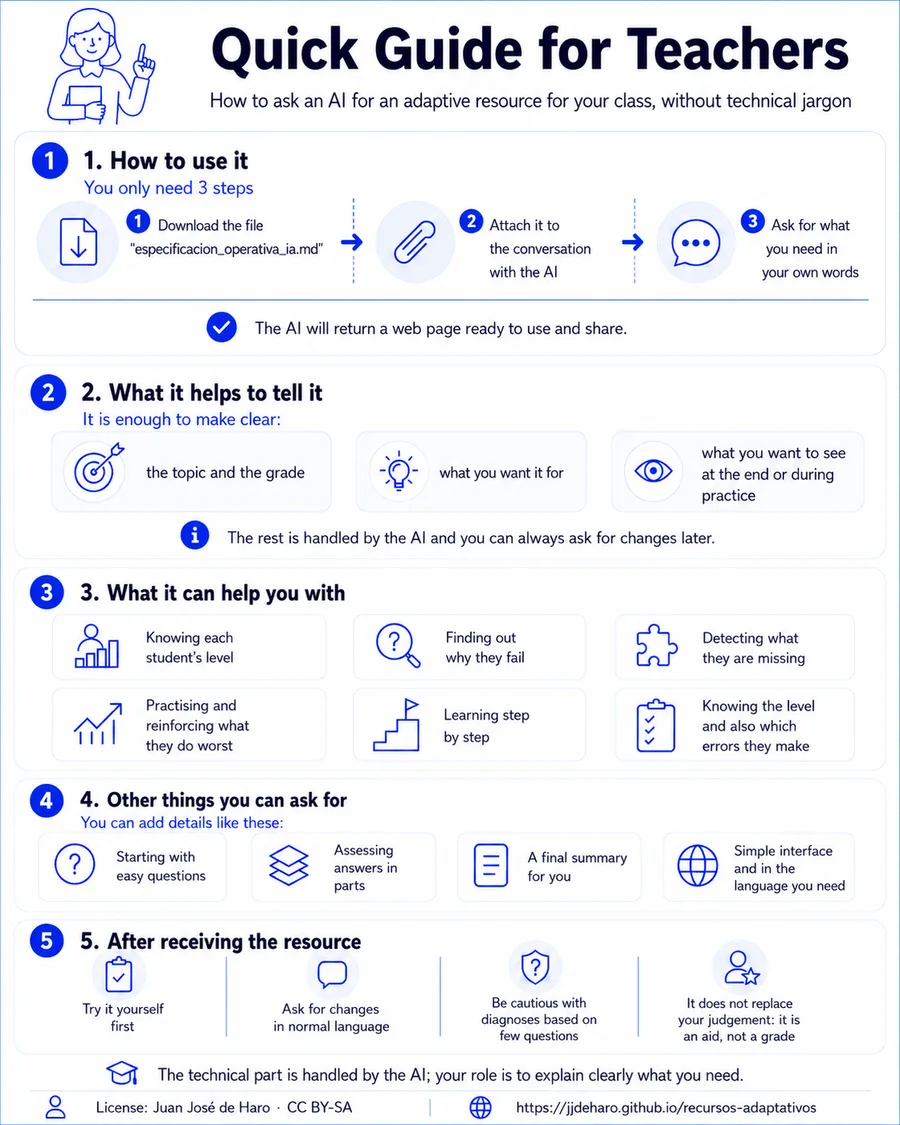
1. How to use it (3 steps)
- Download the file especificacion_operativa_ia_en.md.
- Attach it to the conversation with the AI.
- Ask for what you need in your own words, as you would explain it to a colleague.
With those three steps, you can already start. You do not need to keep reading. If you explain what you need, the AI should be able to create the program and ask only for the essential missing details.
What follows is not a procedure you must complete step by step. It is a guide to help you think about what you can ask for, what options you have, and how to express your idea more clearly if you want to refine the resource.
The AI will return a standalone web page: you can open it in any browser and share it with your students.
2. What it helps to tell the AI
You do not need to fill in a formula. It is enough for your request to make these points clear, in your own words:
- the topic and the school year;
- what you want it for: to know the student's level, find out why they fail, detect gaps, make them practise, guide them step by step...;
- what you want to see at the end or during practice: what information the student and you should receive.
Everything else (number of questions, when it ends, how the result is calculated...) can be handled by the AI with reasonable defaults, and you can always ask for changes later.
3. What you can use it for (with examples)
What most determines the resource is what you want it for. These are the usual purposes, together with what the AI will give you in each case. You do not have to name or ask for a specific type of resource: describe your goal in your own words and the AI chooses the right format. Each purpose also includes a real request as an example, for guidance only: do not copy it word for word; write your own version with your own context.
| If you want to... | What the AI will give you |
|---|---|
| Know the student's level | a test that adapts and estimates their level |
| Find out why they fail | a test that tells apart the possible explanations of the error |
| Detect several possible errors | a test that checks each possible mistake separately |
| Practise what they struggle with most | a trainer that insists on what they master least |
| Learn in stages | a pathway that advances once each stage is mastered |
| Know both level and errors | a test that gives the level and also the specific mistakes |
Know each student's level
A short test that adapts to the student's responses and ends by telling you their level. Useful at the start of a unit, at the end of it, or for grouping students.
A Year 5 primary teacher could ask, for example:
Read the attached document and implement the resource following the operational rules applicable to the requested type of resource. I want a short test to find out the level of my Year 5 pupils in equivalent fractions before starting the unit. At the end, both the student and I should see their level, how reliable the result is, and what would be best to do next.
Find out why they fail
When a student fails and you suspect there is one specific reason behind it (a misconception, an incorrect method they learned), the test can be designed to distinguish which explanation is the right one.
For example, in a lower-secondary language class:
Read the attached document and implement the resource following the operational rules applicable to the requested type of resource. My lower-secondary students struggle to identify the subject of a sentence, and I want to find out why each one fails. Only one of these explanations can be true for each student: either they think the subject is always whatever comes first in the sentence, or they identify it by meaning (who or what the sentence is about) without checking agreement with the verb, or they actually do it correctly. At the end I want to know which explanation is most likely for that student and what I should explain in each case.
Detect several mistakes at once
When possible mistakes can occur at the same time (a student may have one, several, or none), the test checks each one separately and tells you which ones are present.
For example, with decimal operations in Year 6 primary:
Read the attached document and implement the resource following the operational rules applicable to the requested type of resource. I want a test for Year 6 primary that detects which mistakes each student still has when working with decimals. They may have several at once: making errors when subtracting with borrowing, not aligning the decimal point correctly, or placing the zero incorrectly in the quotient. At the end I want to see, for each mistake, whether they have it, do not have it, or whether it is still unclear, and what would be worth reinforcing.
Practise and reinforce what they handle worst
An exercise trainer that adapts on its own: it detects which kinds of exercises the student knows least and proposes more of those. It has no fixed end: the student practises for as long as they want.
For example, for revising fractions in Year 7:
Read the attached document and implement the resource following the operational rules applicable to the requested type of resource. I want a practice program on fraction operations for Year 7 students (addition, subtraction, multiplication and division) that gives more exercises on what each student handles worst. After each response it should say whether it is right or wrong and explain the mistake, with the option to ask for a hint. I want the student to see on screen how they are doing in each type of operation.
Learn step by step
A guided pathway that teaches something in stages. The student does not move on to the next stage until they show that they have mastered the current one; if they get stuck, they receive help and can try again.
For example, to introduce equations:
Read the attached document and implement the resource following the operational rules applicable to the requested type of resource. I want a pathway for my Year 7 students to learn how to solve for x step by step: first equations like x + 3 = 7, then ones like 2x = 10, and finally combined ones like 2x + 3 = 11. They should not move on from one stage until they master it, and they should receive hints and explanations if they get stuck. At the end I want to see which stages each student has completed and where they needed help.
Know the level and also which errors they make
Both things in a single test: the student's general level and their specific mistakes.
For example, with written accents:
Read the attached document and implement the resource following the operational rules applicable to the requested type of resource. I want a written-accent test for lower-secondary students that tells me each student's level and also which specific mistakes they have: they may confuse the rules for acute and grave stress patterns, ignore hiatuses, or fail only with the diacritical accent, and they may have several of these mistakes at once. At the end I want their level, the status of each mistake, and a recommendation: what to practise and what would need to be explained.
4. How to describe the errors
If your resource detects errors, there is a nuance worth getting across: whether for each student only one explanation can be true (they compete with each other) or the student can have several mistakes at the same time (they accumulate).
You do not need any technical term or a special clarification: the AI usually works this out from how you describe the problem. It is enough to describe the errors naturally, as in the earlier examples ("only one of these explanations can be true" versus "the student can have several at once").
An everyday example: "the plant is wilting because you water it too little or because you water it too much" are competing explanations (only one can be the cause: you cannot water it too little and too much at the same time). By contrast, "it is wilting because it lacks light and also lacks fertiliser" can both be true. If you are unsure the AI has understood it correctly, tell it explicitly or check when you try the resource.
5. Other things you can ask for
Add, in your own words, whatever matters to you. Some ideas:
- For younger or insecure students: ask it to begin with an easy question and include some approachable ones from time to time so they do not lose confidence.
- If the exercises have several steps: ask it to evaluate answers in parts, so a half-complete exercise counts as half right rather than a total failure.
- A final summary for you, in addition to the result shown to the student.
- A very simple interface, with large text and clear buttons, if your students are not very confident with digital tools.
- The resource in the language you need.
6. Tips for creating a good resource
- You can use any AI: web chatbots, command-line (CLI) versions, online services, desktop applications, etc. It is advisable to use the most capable model available to you.
- Give the AI any educational documentation you want it to use. In addition to especificacion_operativa_ia_en.md, you can include documents with your own questions, examples, or theory.
- Creating an adaptive application is a dialogue with the AI: the more detail you provide at the beginning and throughout the process, the better it will understand what you need.
- Once you have a preliminary version, ask it to check point by point whether it has followed the operational specification and to correct any failures to comply.
- Check that there are enough questions. The first version may contain only a few, just enough to work but not enough for a useful application. Ask the AI to create more if you think they are needed. You can do this in several batches if you reach the message limit. If the question bank will be very large, it is best to ask the AI to put the questions in a JSON file, which makes them easier to manage (only when using an AI that can work with several files, such as CLI versions or services like Google AI Studio).
- If you notice unnatural behaviour, such as always starting with the same questions, tell the AI to fix it.
- Do not provide students' personal data, and check that you may reuse any materials you supply. Also keep a copy of each working version before requesting major changes.
7. After receiving the resource
- Always test the program to make sure it really does what you want, and tell the AI about any problem or shortcoming you identify.
- Review the content, not the technique: the AI will hand you a short checklist along with the resource (are the errors the ones your students actually make?, do the questions fit the grade?, are the answers and explanations correct?, is any important case missing?, is the language right for the age?). That is what you can validate better than anyone; the method takes care of the mathematical side.
- Ask for changes in plain language: "make it shorter", "the questions are too difficult for my class", "add more division exercises", "explain the errors with examples". You do not need technical terms.
- Be cautious with diagnoses based on very few questions: the resource itself should warn you when a result is provisional. Treat it as guidance, not as a verdict.
- The result never replaces your professional judgment: it is an aid for decision-making, not a grade.
This guide is part of the Protocol for Bayesian adaptive educational systems. If you want to understand how it works inside, the full explanation is there.
How to cite (APA 7): de Haro, J. J. (2026). Quick guide for teachers — Protocol for Bayesian adaptive educational systems (version 1.2). https://jjdeharo.github.io/recursos-adaptativos/